SILENT WARFARE
Pasco’s Front Line Against Mosquitoes
JOE POTTER
While they may be small, mosquitoes threat to public health is significant.
As the 2025 Atlantic Hurricane Season begins, Pasco County Mosquito Control District (PCMCD)
is stepping up its efforts to
combat mosquito populations with a combination of innovation, public service, and proven science.
“We’re not just out there spraying, we’re implementing a fully integrated strategy
that combines technology, data, and public outreach to reduce mosquito populations and protect our residents,” said Adriane Rogers, Executive Director of PCMCD.
East Pasco communities were hit hard in 2024 when major hurricanes caused
unprecedented flooding, creating months of stagnant water followed by a spike in mosquito populations. In the storms’ wake, PCMCD did more than just control mosquitoes.
“It was all hands on deck,” Rogers said. “Our team mobilized quickly, not only to respond to the mosquito threat but also to directly assist our community during a time of crisis.”
Staff assisted in critical water rescues, helping evacuate residents from homes inundated by flooding.
“Every season brings new challenges, and after last year’s historic flooding, we’re especially focused on proactive strategies that reduce mosquito populations and protect public health,” Rogers said.
Now, heading into another rainy season, PCMCD is ramping up innovative
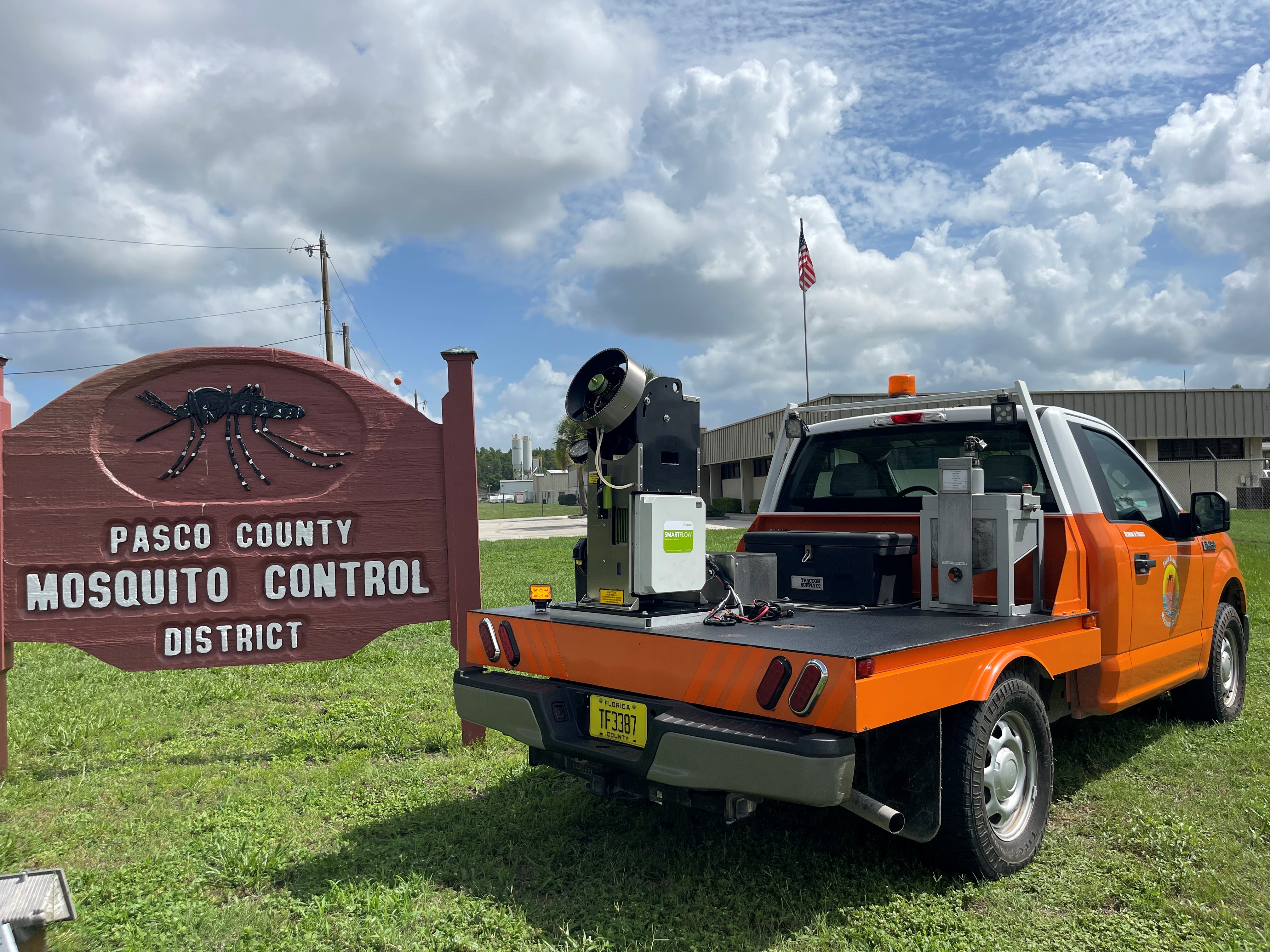
approaches. The first is using electric Ultra Low Volume spray systems, which are environmentally responsible, quieter, and more cost-effective than traditional gas-powered equipment. Funded by a grant from the Centers for Disease Control and
Prevention, the new systems save the District an estimated $10,000 annually in fuel and maintenance costs.
“Residents may not hear the trucks like they used to, but our treatments are just as effective,” said Rogers.
“You’ll still spot the trucks easily thanks to their bright LED lighting.”
Another groundbreaking initiative underway is PCMCD’s Sterile Insect Technique trial. This proof-
of-concept project involves
male Aedes aegypti mosquitoes into a designated 30-acre site in West Pasco. “These sterile males mate with wild female mosquitoes responsible for transmitting dengue and other viruses but the resulting eggs don’t hatch. It’s a safe, targeted, non-chemical method to reduce mosquito populations over time,”
Rogers explained.
“If successful, it could become a long-term strategy in our integrated mosquito mgmnt program. A second site is being used as a control to track effectiveness,” Rogers said.
PCMCD’s approach is rooted in integrated mosquito management, a combination of surveillance, prevention, public education, source reduction, and treatment.
The agency collects and analyzes mosquito data daily, enabling precise, data-driven decisions to manage mosquito-borne disease risk.
Fifty year-round staff and 13 seasonal team members cover the District’s 868 square miles, providing services that protect residents and visitors countywide. “We use science to drive every decision we make,” Rogers said.
“Our mission is to protect public health, and our team works tirelessly to stay ahead of mosquito trends and respond quickly when conditions change.”
Rogers emphasizes that residents can play an essential role in controlling
mosquitoes.
How You Can Help
- Dump and drain standing water on your property, even a bottle cap of water
can breed mosquitoes.
- Repair window/door
screens to keep mosquitoes
out of your home. - Wear insect repellent and long sleeves when outdoors, especially during
dawn and dusk.
“Mosquito control is a shared responsibility. We’re doing everything
we can, from science to service, but we need the community’s help too.
Together, we can fight the bite and reduce the risk of diseases like West Nile
and dengue,” Rogers said.
To stay informed or report mosquito activity, visit
www.pascomosquito.org or call (727) 376-4568. ©